Research - (2026) Volume 21, Issue 1
Resistance training among active women: motivations, barriers, and its role in self-esteem and body satisfaction
Jessica Vaz Velho Sebastião de Melo1*, Nuno Miguel Prazeres Batalha1,2 and Gabriela Sousa Neves de Almeida1,2*Correspondence: Jessica Vaz Velho Sebastião de Melo, Department of Sport and Health, University of Evora, Portugal, Email:
Abstract
Resistance training (RT) has been increasingly recognized as a relevant health behavior among women, with potential benefits extending beyond physical health to psychological well-being. However, adherence to RT remains influenced by multiple individual and contextual factors. This cross-sectional study aimed to examine RT adherence among physically active women, focusing on motivational and perceived barriers, as well as exploring associations with self-esteem and body satisfaction. A total of 240 physically active women (30.69 ± 8.87 years) answered a questionnaire about training habits, motivations and barriers associated with adherence to the RT. They also completed the Rosenberg Self-Esteem Scale and the Silhouette Rating Scale. Most participants (80.8%) reported engaging in RT. Women who are single and without minor or dependent children engage in RT more frequently than those with a partner and children. Improving physical fitness and health (physical and mental) are the main motivations for the practice of RT, and lack of commitment and motivation are the main barriers. No statistically significant differences were found between RT practitioners and non-practitioners in self-esteem or body satisfaction. However, women with longer RT experience (≥1 year) reported greater body satisfaction, and practitioners tended to perceive their bodies more positively. These findings highlight the role of psychological and contextual factors in RT adherence among women and suggest that sustained engagement in RT may be associated with more positive body perception over time.
Keywords
women adherence; resistance training; physical exercise; self-esteem; body satisfaction; motivations.
Introduction
The World Health Organization (2020) recommends that adults engage in muscle-strengthening activities of moderate or greater intensity, involving the major muscle groups, at least two days per week.
Resistance training is a broad term encompassing various exercise methods designed to increase muscular strength, power, and endurance through resistance provided by machines, free weights (such as barbells, dumbbells, medicine balls, kettlebells, resistance bands), or body weight (Stricker et al., 2020).
In recent years, there has been a notable increase in the number of women engaging in physical activity, particularly in fitness centers (Fernández-Martínez et al., 2020). Among these activities, participation in resistance training has gained particular prominence, signalling a shift in traditional perceptions of fitness and health. An increase number of women are adopting resistance training, recognizing its value not only in physical wellbeing but also in psychological health. In addition to its physiological benefits, regular resistance training has been linked to improvements in self-esteem, self-confidence, body image, and self-acceptance among women (Asçi, 2003; Ossip-Klein et al., 1989).
Several studies highlight common barriers to resistance training among women, such as social stereotypes, lack of motivation, fear of judgment or harassment, and unfamiliarity with the gym environment (Ford et al., 2023; Grogan, 2016; Kanel & Rellinger, 2019). Additional factors like family responsibilities, time constraints, and life routine changes also affect adherence (Arikawa et al., 2011; White et al., 2005).
Research suggests that adult physical activity adherence is associated with habits developed during adolescence, such as high levels of activity, access to nearby gyms, and frequent participation in physical education classes (Sun et al., 2017). Women’s motivations tend to be extrinsic, focused on appearance and weight control (Kilpatrick et al., 2005) though intrinsic motivation is essential for long-term adherence (Dabrowska-Galas & Dabrowska, 2021). Despite its health benefits, many women are driven to engage in resistance training to enhance physical appearance (Grogan, 2016).
Self-esteem refers to the subjective evaluation an individual makes of themselves, influenced by self-related beliefs and emotions (Huitt, 2009). It is closely related to self-concept, representing a more specific assessment of how one sees oneself. According to Rosenberg (1989), global self-esteem expresses an overall positive or negative orientation toward the self. It is also linked to self-efficacy, self-respect, and self-acceptance (Palenzuela-Luis et al., 2022), which directly influence mental health, interpersonal relationships, and general wellbeing.
Body image, on the other hand, refers to an individual’s perceptions, thoughts, and feelings about their physical appearance. This concept is key to understanding how women perceive their bodies in relation to societal standards. A positive body image is strongly associated with higher levels of self-esteem. Women who are satisfied with their body image tend to have greater overall self-esteem (Grogan, 2016).
Body image is considered an essential component of global self-esteem in women and is influenced by factors such as BMI, media-imposed beauty standards, and bodily changes throughout life (Olchowska-Kotala, 2017; Pop, 2016; Pruis & Janowsky, 2010). Body dissatisfaction is often linked to lower levels of self-esteem (Rudd & Lennon, 2000) and is intensified by comparisons with idealized and unattainable images (Carter & Vartanian, 2022). The pressure to conform to the thin and toned body ideal leads many women to adopt extreme behaviors to achieve a socially valued appearance (Donovan & Uhlmann, 2022; Grogan, 2016).
Physical activity, especially resistance training, has been associated with significant improvements in women’s self-esteem and body (Dabrowska-Galas & Dabrowska, 2021; Grogan, 2016). In addition to its physical benefits, resistance training can promote self-efficacy, self-satisfaction, and empowerment (Asçi, 2003; Collins et al., 2019). Studies show that consistent training programs contribute to a more positive self-concept and greater body satisfaction (Brazell-Roberts & Thomas, 1989; Velez et al., 2010). Therefore, consistent practice can strengthen not only the body but also women’s mental and emotional health.
This study aimed to analyze resistance training adherence among physically active women, considering training frequency, volume, and habits, as well as to identify the main factors that motivate or hinder this practice. It also sought to explore the role of resistance training in self-esteem and body image satisfaction.
Method
Study Design and Procedures
This cross-sectional study was conducted in accordance with the principles of the Declaration of Helsinki, current ethical and legal standards and received approval from the Ethics Committee of the University of Évora. All procedures followed national regulations regarding research with human participants, ensuring confidentiality and anonymity throughout the study. Data collection was conducted online using a Google Forms questionnaire, which was accessible from February 26 to May 30, 2024. The questionnaire link was disseminated through social media platforms, targeting physically active women. Participation was voluntary, and only one submission per participant was allowed through Google Forms’ settings to prevent duplicate responses. On the first page of the questionnaire, participants were presented with an informed consent statement outlining the study's objectives, procedures, risks, and confidentiality measures. Only participants who actively agreed to participate by selecting the acceptance option were granted access to the questionnaire.
Participants
The study was conducted with adult women aged between 18 and 64 years, who were physically active, that is, engage in physical activities at least twice per week, for more than 60 minutes weekly, and walked more than 5000 steps per day (monitored via technological devices). The demographic and anthropometric characteristics of participants are displayed in table 1. A total of 264 women were recruited, however, 24 were excluded for not meeting the inclusion criteria (Figure 1), resulting in a final of 240 participants (Figure 1).
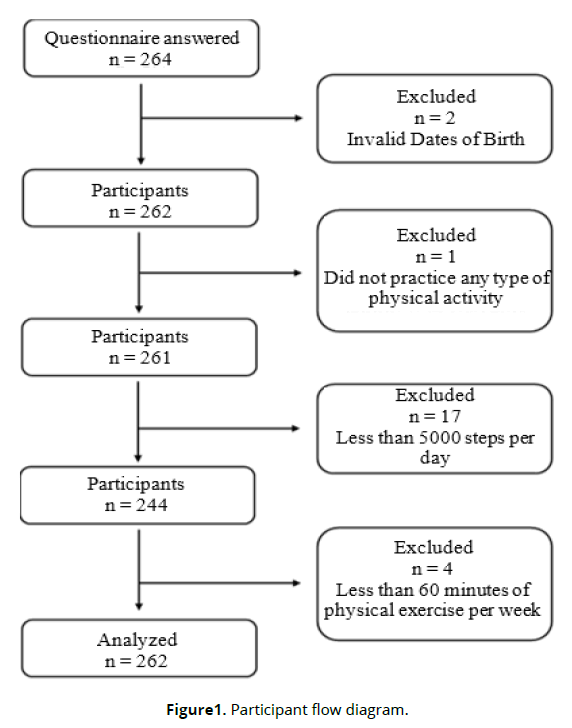
Figure 1. Participant flow diagram.
The participants were divided according to marital status: women without a partner (single, divorced, or widowed, n = 174) and women with a partner (married or in a domestic partnership, n = 66). Around 79.6% (n = 191) of the participants reported not having dependent children, while 20.4% (n = 49) confirmed having them (Table 1).
| Variable | Mean (± SD) | Minimum | Maximum |
|---|---|---|---|
| Age (years) | 30.69 ± 8.87 | 18 | 61 |
| Weight (kg) | 62.04 ± 11.43 | 40 | 115 |
| Height (m) | 1.62 ± 0.06 | 1.4 | 1.8 |
| Body Mass Index (kg/m²) | 23.46 ± 3.81 | 17.2 | 39.7 |
Table1. Demographic and Anthropometric Characteristics of Participants (n=240).
Measures and instruments
The questionnaire comprised three sections: Sociodemographic and Resistance Training Adherence Questionnaire, developed for this study to capture participants' background and training habits; Self-Esteem Scale (Rosenberg Self-Esteem Scale); Body Image Satisfaction Scale (Silhouette Rating Scale).
Sociodemographic characteristics and resistance training adherence
A structured questionnaire “Sociodemographic and Resistance Training Adherence Questionnaire” was developed specifically for this study to collect data on participants' sociodemographic characteristics and resistance training (RT) adherence (see Supplementary File 1 for the full English version of the questionnaire). Content validity was assessed by two exercise physiology experts, who evaluated each item for relevance, clarity, simplicity, and ambiguity. The final version was informed by literature, expert recommendations, and the author's professional experience as a Personal Trainer (PT).
In the first section of the questionnaire, items were used to collect sociodemographic information, including date of birth, weight, height (used to calculate BMI), marital status, and the presence of dependent children.
The second section included questions about participants’ physical activity habits (type of resistance training, company during training, training planning, and location of resistance training), such as weekly frequency, how long they have been practicing TF and participation in sports. Women who reported regular RT participation were asked to indicate perceived motivations using a multiple-response checklist created based on the literature, but also on suggestions from experts and on the author's personal experiences as a PT: “To improve my physical fitness”, “To reduce body fat”, “To gain muscle mass”, “To improve my health”, “To socialize “, “Because I enjoy it“, “Because it makes me feel good”, “To improve my mental health“, “To reduce anxiety/depression”, “To rehabilitate an injury”. Those who reported not engaging in RT completed a Likert-scale section (1 = strongly disagree to 5 = strongly agree) regarding their barriers for engaging in RT (see table 2 for the statements).
| Test-retest Reliability | P | |
|---|---|---|
| ICC (n=11) | ||
| Q1. I don’t have time | 0.441 | 0.06 |
| Q2. I don’t have the financial means | 0.832 | <0.001* |
| Q3. I am not motivated | 0.659 | 0.005* |
| Q4. I don’t have anyone to train with | 0.808 | <0.001* |
| Q5. I don’t see the need | 0.816 | <0.001* |
| Q6. I don’t know how to train | 0.767 | 0.002* |
| Q7. The gym is far from home or work | 0.66 | 0.009* |
| Q8. I’m afraid of being judged | 0.867 | <0.001* |
| Q9. I’m afraid of being watched or harassed | 0.835 | <0.001* |
| Q10. I’m afraid of becoming too muscular | 0.781 | 0.002* |
| Q11. I think resistance training is more suitable for men | -0.111 | 0.621 |
| Q12. I’ have little information about the benefits of resistance training | 0.91 | <0.001* |
| Q13. I feel discomfort or pain when doing resistance training | 0.795 | <0.001* |
| Q14. I believe I’m too old for resistance training | 0.681 | 0.009** |
| Q15. I lack commitment or discipline | 0.771 | 0.002* |
| Q16. I’m unable to define realistic goals | 0.974 | <0.001* |
| Q17. I can’t rest or sleep well | 0.825 | <0.001* |
| Q18. I had negative past experiences | 0.906 | <0.001* |
Table 2. Test-retest reliability of the subscale on barriers to resistance training.
An exploratory test-retest reliability study was conducted to assess the temporal stability of the RT barriers subscale. Eleven physically active women who did not engage in RT completed the barriers questionnaire twice, one week apart. Intra-class correlation coefficients (ICCs) were calculated to determine item stability over time. ICC values <0.50 were interpreted as poor, 0.50–0.75 as moderate, 0.75–0.90 as good, and >0.90 as excellent (Koo & Li, 2016). Internal consistency was also evaluated using Cronbach’s alpha, with values ≥0.70 considered acceptable (Cronbach, 1951). Based on the reliability results, two items (Q1 and Q11) were excluded due to low ICC values and inadequate internal consistency, resulting in a questionnaire with 16 items (Table 2). Most items demonstrated good to excellent temporal stability, with ICC values ranging from 0.659 to 0.974 (Table 2).
Self-esteem
The Rosenberg Self-Esteem Scale (RSES), developed by Morris Rosenberg in 1965, is widely used to assess individual self-esteem. It consists of ten items rated on a 4-point Likert scale from “4 – Strongly Disagree” to “1 Strongly Agree.” Positive statements (1, 3, 4, 7, 10) are scored directly, while negative statements (2, 5, 6, 8, 9) are reverse-scored. The total score is the sum of all items, with higher scores indicating greater self-esteem (Pechorro et al., 2011; Rocha, 2011).
Body image satisfaction
The Silhouette Rating Scale (SRS) is a universally validated tool to assess body satisfaction (Lombardo et al., 2022). It consists of nine numbered silhouettes (1 to 9), ranging from very thin to very heavy. Participants first choose the figure that best represents their current body (Current Body Image, SRS-C), followed by the figure that represents their ideal body (Ideal Body Image, SRS-I). The discrepancy between the two is considered a good measure of body dissatisfaction (SRS-D). Negative values indicate a preference for a thinner body, while positive values indicate a preference for a heavier body.
Data analysis
Data were analyzed using SPSS software (v.27.0). Statistical significance was set at p < .05. Descriptive analysis was performed, including frequencies, means, standard deviations, minimum and maximum values. Data normality was tested using the Kolmogorov-Smirnov test. As BMI, age, and self-esteem did not follow a normal distribution, non-parametric tests (Mann-Whitney and Kruskal-Wallis) were used for group comparisons. Chi-square tests were applied to assess associations between categorical variables. Correlations between continuous variables were analyzed using Spearman and Pearson coefficients. Linear regressions were conducted to adjust for the covariate age, followed by ANCOVA for comparing groups with age as a control variable.
Results
Adherence to Resistance Training
Of the 240 women participants, 194 (80.8%) engage in resistance training and 46 (19.2%) do not. Among those who do, approximately half combine resistance training with another type of physical exercise (40.4%), while the other half practice resistance training exclusively (40.4%). The majority of women who engage in any form of physical activity include RT in their routine (67.8%).
No statistically significant differences were found in RT participation based on age (p = 0.998, U = 4461.00), current relationship status (p = 0.388), or the presence of minor or dependent children (p = 0.513). Nonetheless, a higher proportion of women without a partner (82.2%) and without minor or dependent children (81.7%) reported engaging in resistance training.
Regarding current relationship status, women without a partner engage in resistance training more frequently (p = 0.006). Among them, 47.94% train three to four times per week, compared to 10.31% of women with partner. Women with partner show a lower training frequency, especially among those training one to two times per week. Concerning the presence of children, women without minor or dependent children also train more frequently (p = 0.022). 48.97% of these women train three to four times per week, compared to 9.28% of those with children. Therefore, RT is more common among women without a partner and without minor or dependent children. No significant differences were observed between participants’ age and training frequency (p = 0.121; H = 4.223).
Preferences for the type of resistance training, company during training, training planning, and location of resistance training
Regarding the preferred modality of resistance training, weight training in the gym stands out as the most common choice (80.4%), with 35.6% of women practicing it exclusively. This is followed by bodyweight training (36.6%), group classes with resistance (32.5%), and the use of free weights (30.9%), all with lower percentages of exclusive practice. Many participants combine two or more modalities. Additionally, 6.7% report practicing CrossFit and 3.6% calisthenics.
When it comes to training companionship, most women (39.2%) prefer to train exclusively alone. Others report training only with friends, family, or acquaintances (16.5%), or solely with a PT (15.5%). Some combine different types of companionship: 13.9% train alone and with acquaintances; 6.7% alone and with a PT; 6.2% with acquaintances and a PT; and 2.1% combine all three. Overall, there is a clear preference for solo training.
In terms of training planning, most women (39.2%) rely exclusively on an individual plan. A considerable proportion (27.8%) follow guidance solely from a PT, while 6.7% use only social media videos. Mixed approaches are also present: 8.8% combine a plan and a PT; 6.7% use a plan and videos; 1.0% rely on videos and a PT; and 0.5% use all three sources. Additionally, 9.3% do not follow any structured planning.
As for the training location, the vast majority (76.3%) train exclusively at the gym. Smaller groups train only at home (4.6%) or outdoors (2.1%). Some participants combine locations: 7.2% train at both the gym and at home; 3.1% at the gym and outdoors; 1.5% at home and outdoors; and 3.1% use all three. Moreover, 2.1% train exclusively at a CrossFit box.
Motivations for Engaging in Resistance Training
Table 3 summarizes the motivational reasons reported by the 194 women who engage in RT. The most common motivations were improving physical fitness (88.14%; n=171), health (74.23%; n=144), and mental health (69.59%; n=135). Women without a partner or children more often reported increasing muscle mass (65.98%; n=128), whereas those with a partner emphasized well-being (62.37%; n=121). The only statistically significant difference was in the motivation “reducing anxiety/depression” (44.84%; n=87), which was more frequently cited by women without a partner (p = 0.024).
| Current relationship status | Minor or dependent children | |||||||||||
|---|---|---|---|---|---|---|---|---|---|---|---|---|
| Without partner (n=143) | With partner (n=51) | p(a) | No (n=156) | Yes (n=38) | p(b) | Total | ||||||
| n | % | n | % | n | % | n | % | n (%) | ||||
| To improve my physical fitness | 128 | 89.51 | 43 | 84.31 | 0.324 | 137 | 87.82 | 34 | 89.47 | - | 171 (88.14) | |
| To reduce body fat | 74 | 51.74 | 29 | 56.86 | 0.53 | 81 | 51.92 | 22 | 57.89 | 0.508 | 103 (53.09) | |
| To gain muscle mass | 96 | 67.13 | 32 | 62.74 | 0.57 | 102 | 65.38 | 26 | 68.42 | 0.723 | 128 (65.98) | |
| To improve my health | 102 | 71.33 | 42 | 82.35 | 0.122 | 112 | 69.23 | 32 | 84.42 | 0.117 | 144 (74.23) | |
| To socialize | 10 | 6.99 | 3 | 5.88 | - | 7 | 4.49 | 6 | 15.79 | - | 13 (6.70) | |
| Because I enjoy it | 50 | 34.96 | 16 | 31.37 | 0.642 | 51 | 32.69 | 15 | 39.47 | 0.429 | 66 (34.02) | |
| Because it makes me feel good | 87 | 60.84 | 34 | 66.67 | 0.461 | 97 | 62.18 | 24 | 63.16 | 0.911 | 121 (62.37) | |
| To improve my mental health | 101 | 70.63 | 34 | 66.67 | 0.597 | 107 | 68.59 | 28 | 73.68 | 0.54 | 135 (69.59) | |
| To reduce anxiety/depression | 71 | 49.65 | 16 | 31.37 | 0.024* | 73 | 46.79 | 14 | 36.84 | 0.259 | 87 (44.84) | |
| To rehabilitate an injury | 11 | 7.69 | 4 | 7.84 | - | 11 | 7.05 | 4 | 10.53 | - | 15 (7.73) | |
| Because my profession requires it | 1 | 0.7 | 0 | 0 | - | 1 | 0.64 | 0 | 0 | - | 1 (0.52) | |
| To set an example for my children | 0 | 0 | 1 | 1.96 | - | 0 | 0 | 1 | 2.63 | - | 1 (0.52) | |
Table 3. Motivations for resistance training practice by current relationship status and children under age or dependent (n = 194).
Barriers to Resistance Training Practice
Table 4 presents the barriers reported by the 46 women in the study who do not engage in resistance training, with responses rated on a Likert scale. The main barriers were “Lack of commitment” and “Lack of motivation”, while “I’m not the right age to practice” and “Fear of becoming too muscular” had the lowest averages. The barrier “I don’t have realistic goals” received a neutral average score, suggesting that although it is not one of the main barriers, it may still influence adherence to resistance training.
| Current relationship status | Minor or dependent children | ||||||
|---|---|---|---|---|---|---|---|
| Without partner (n=31) | With partner | No | Yes | Total | |||
| (n=15) | (n=35) | (n=11) | |||||
| M ± SD | M ± SD | p(a) | M ± SD | M ± SD | p(b) | M ± SD | |
| I don’t have the financial means | 2.48 ± 1.36 | 1.87 ± 1.13 | 0.131 | 2.23 ± 1.24 | 2.45 ± 1.57 | 0.608 | 2.28 ± 1.31 |
| I am not motivated | 3.23 ± 1.33 | 3.20 ± 1.15 | 0.344 | 3.17 ± 1.29 | 3.36 ± 1.21 | 0.728 | 3.22 ± 1.26 |
| I don’t have anyone to train with | 2.87 ± 1.54 | 2.60 ± 1.06 | 0.533 | 2.86 ± 1.44 | 2.55 ± 1.29 | 0.481 | 2.78 ± 1.40 |
| I don’t see the need | 1.84 ± 1.24 | 2.40 ± 1.50 | 0.245 | 2.03 ± 1.34 | 2.00 ± 1.41 | 0.638 | 2.02 ± 1.34 |
| I don’t know how to train | 2.94 ± 1.61 | 2.33 ± 1.18 | 0.059 | 2.83 ± 1.52 | 2.45 ± 1.44 | 0.221 | 2.74 ± 1.50 |
| The gym is far from home or work | 2.10 ± 1.37 | 2.47 ± 1.13 | 0.11 | 2.17 ± 1.36 | 2.36 ± 1.12 | 0.367 | 2.22 ± 1.30 |
| I’m afraid of being judged | 2.68 ± 1.49 | 1.73 ± 1.16 | 0.133 | 2.51 ± 1.44 | 1.91 ± 1.45 | 0.629 | 2.37 ± 1.45 |
| I’m afraid of being watched or harassed | 2.71 ± 1.49 | 1.60 ± 0.99 | 0.020* | 2.51 ± 1.46 | 1.82 ± 1.25 | 0.267 | 2.35 ± 1.43 |
| I’m afraid of becoming too muscular | 1.87 ± 1.36 | 1.73 ± 0.88 | 0.3 | 1.83 ± 1.22 | 1.82 ± 1.25 | 0.625 | 1.83 ± 1.22 |
| I’ have little information about the benefits of resistance training | 2.48 ± 1.46 | 2.13 ± 1.25 | 0.102 | 2.34 ± 1.37 | 2.45 ± 1.51 | 0.565 | 2.37 ± 1.39 |
| I feel discomfort or pain when doing resistance training | 2.29 ± 1.40 | 2.00 ± 1.20 | 0.245 | 2.20 ± 1.28 | 2.18 ± 1.54 | 0.532 | 2.20 ± 1.33 |
| I believe I’m too old for resistance training | 1.39 ± 0.8 | 1.53 ± 0.83 | 0.634 | 1.37 ± 0.73 | 1.64 ± 1.03 | 0.511 | 1.43 ± 0.81 |
| I lack commitment or discipline | 3.58 ± 1.06 | 2.87 ± 0.92 | 0.054 | 3.43 ± 1.09 | 3.09 ± 0.94 | 0.505 | 3.35 ± 1.06 |
| I’m unable to define realistic goals | 2.77 ± 1.28 | 2.80 ± 0.94 | 0.945 | 2.80 ± 1.21 | 2.73 ± 1.10 | 0.844 | 2.78 ± 1.17 |
| I can’t rest or sleep well | 2.77 ± 1.45 | 2.67 ± 1.45 | 0.901 | 2.71 ± 1.47 | 2.82 ± 1.40 | 0.495 | 2.74 ± 1.44 |
| I had negative past experiences | 1.81 ± 1.11 | 2.13 ± 1.13 | 0.458 | 1.77 ± 0.97 | 2.36 ± 1.43 | 0.314 | 1.91 ± 1.11 |
Table 4. Participants responses regarding the barriers to engaging in resistance training (n=46)
An analysis of covariance (ANCOVA) revealed a significant difference (p = 0.020) in responses to the barrier “Fear of being watched/harassed,” which was more frequent among women without a partner compared to those with a partner.
For both women with underage or dependent children and those without children, the most frequently cited barriers were “Lack of motivation” and “Lack of commitment.” No statistically significant differences were found between the two groups (p > 0.05).
Additionally, 58.7% of women who do not engage in resistance training stated that they would be willing to start if the barriers were removed, while 41.3% indicated that they would still not wish to begin training, even in the absence of barriers.
Self-esteem
The average self-esteem score, assessed using the RSES, was 31.23 ± 4.72, indicating generally high levels (Table 5). Women who practiced resistance training had slightly higher scores than non-practitioners, though the difference was not statistically significant. Self-esteem was weakly to moderately positively correlated with age (rs = 0.299; p < 0.001), but showed no significant association with BMI, relationship status, or having dependent children after, controlling for age.
| Current relationship status | Minor or dependent children | Practices Resistance Training | |||||
|---|---|---|---|---|---|---|---|
| Without partner (n=176) | With partner | No | Yes | No | Yes | Total | |
| (n=66) | (n=35) | (n=11) | (n=46) | (n=194) | |||
| M ± SD | M ± SD | M ± SD | M ± SD | M ± SD | M ± SD | M ± SD | |
| 1. On the whole, I am satisfied with myself. | 2.78 ± 0.73 | 3.00 ± 0.72 | 2.82 ± 0.71 | 2.92 ± 0.81 | 2.61 ± 0.86 | 2.90 ± 0.69 | 2.84 ± 0.73 |
| 2. At times, I think I am no good at all. | 2.97 ± 0.86 | 3.32 ± 0.79 | 2.99 ± 0.86 | 3.37 ± 0.76 | 3.00 ± 0.89 | 3.08 ± 0.85 | 3.07 ± 0.86 |
| 3. I feel that I have a number of good qualities. | 3.28 ± 0.52 | 3.44 ± 0.53 | 3.28 ± 0.52 | 3.49 ± 0.54 | 3.37 ± 0.57 | 3.31 ± 0.52 | 3.33 ± 0.83 |
| 4. I am able to do things as well as most other people. | 3.26 ± 0.63 | 3.38 ± 0.52 | 3.27 ± 0.61 | 3.39 ± 0.53 | 3.33 ± 0.67 | 3.29 ± 0.58 | 3.30 ± 0.60 |
| 5. I feel I do not have much to be proud of. | 3.33 ± 0.78 | 3.52 ± 0.77 | 3.32 ± 0.81 | 3.61 ± 0.64 | 3.24 ± 0.85 | 3.41 ± 0.77 | 3.38 ± 0.78 |
| 6. I certainly feel useless at times. | 2.95 ± 0.90 | 3.39 ± 0.68 | 2.98 ± 0.88 | 3.45 ± 0.71 | 2.96 ± 0.92 | 3.10 ± 0.86 | 3.07 ± 0.87 |
| 7. I feel that I'm a person of worth. | 3.31 ± 0.59 | 3.30 ± 0.53 | 3.29 ± 0.57 | 3.39 ± 0.57 | 3.22 ± 0.70 | 3.33 ± 0.53 | 3.31 ± 0.57 |
| 8. I wish I could have more respect for myself. | 2.17 ± 0.91 | 2.76 ± 0.96 | 2.25 ± 0.93 | 2.67 ± 1.03 | 2.20 ± 1.00 | 2.37 ± 0.95 | 2.33 ± 0.96 |
| 9. All in all, I am inclined to think that I am a failure. | 3.43 ± 0.72 | 3.68 ± 0.59 | 3.47 ± 0.70 | 3.61 ± 0.64 | 3.20 ± 0.91 | 3.57 ± 0.61 | 3.50 ± 0.69 |
| 10. I take a positive attitude toward myself. | 3.06 ± 0.72 | 3.26 ± 0.59 | 3.06 ± 0.70 | 3.33 ± 0.63 | 3.04 ± 0.76 | 3.13 ± 0.67 | 3.11 ± 0.69 |
| Total (points) (M ± SD) | 30.55 ± 4.85 | 33.05 ± 3.83 | 30.72 ± 4.65 | 33.22 ± 4.52 | 30.15 ± 5.44 | 31.49 ± 4.51 | 31.23 ± 4.72 |
| p(a) | 0.103 | 0.25 | 0.14 | ||||
Table 5. Responses to the Rosenberg Self-Esteem Scale (RSES) items (n = 240).
Body Satisfaction
According to Table 6, on average, participants wished to have a thinner silhouette than the one they currently perceive and a discrepancy of approximately one silhouette (SRS-D = -0.71 ± 0.97; |SRS-D| = 0.92 ± 0.77). Additionally, 68 participants reported no difference between their current and ideal silhouette, indicating satisfaction with their current body shape, 57 of whom practiced resistance training. Women who engaged in resistance training reported slightly thinner silhouettes (3.67 ± 1.19 vs. 3.91 ± 1.30) and greater body satisfaction (0.91 ± 0.78 vs. 0.96 ± 0.76), although these differences were not statistically significant (p > 0.05). However, women who had been training for more than one year reported significantly greater body satisfaction (0.81 ± 0.74) than those who had been training for less than a year (1.08 ± 0.82), with statistical significance (Z = 5.599; p = 0.019).
| Current relationship status | Minor or dependent children | Practices Resistance Training | ||||||
|---|---|---|---|---|---|---|---|---|
| Without partner (n=176) | With partner | No | Yes | No | Yes | Total | ||
| (n=35) | (n=11) | (n=46) | (n=194) | |||||
| Current Body Image | M ± SD | 3.75 ± 1.21 | 3.62 ± 1.24 | 3.74 ± 1.18 | 3.61 ± 1.37 | 3.91 ± 1.31 | 3.67 ± 1.19 | 3.72 ± 1.21 |
| (SRS-C) | Max. | 8 | 8 | 8 | 8 | 8 | 8 | 8 |
| Min. | 1 | 1 | 1 | 1 | 2 | 1 | 1 | |
| Ideal Body Image | M ± SD | 3.01 ± 0.75 | 2.98 ± 0.83 | 2.99 ± 0.76 | 3.06 ± 0.83 | 3.22 ± 0.84 | 2.95 ± 0.75 | 3.00 ± 0.77 |
| (SRS-I) | Max. | 5 | 4 | 5 | 4 | 5 | 5 | 5 |
| Min. | 1 | 1 | 1 | 1 | 1 | 1 | 1 | |
| SRS-D | M ± SD | -0.74 ± 0.97 | -0.64 ± 0.99 | -0.75 ± 0.94 | -0.55 ± 1.06 | -0.70 ± 1.01 | -0.72 ± 0.96 | -0.71 ± 0.97 |
| | SRS-D | | M ± SD | 0.95 ± 0.76 | 0.85 ± 0.81 | 0.93 ± 0.77 | 0.88 ± 0.81 | 0.96 ± 0.76 | 0.91 ± 0.78 | 0.92 ± 0.77 |
| p(a) | 0.323 | 0.648 | 0.722 | |||||
Table 6. Responses to the Silhouette Rating Scale (SRS) items (n=240)
Women without a partner reported more robust silhouettes (3.75 ± 1.21 vs. 3.62 ± 1.24) and lower body satisfaction (0.95 ± 0.76 vs. 0.85 ± 0.81), as did those without minor or dependent children (silhouette: 3.74 ± 1.18 vs. 3.61 ± 1.37; satisfaction: 0.93 ± 0.77 vs. 0.88 ± 0.81), although these differences were also not statistically significant (p > 0.05). Pearson correlation analysis revealed a moderate, statistically significant negative relationship between BMI and silhouette discrepancy (r = -0.624; p < 0.001), suggesting that women with higher BMI tend to report greater body dissatisfaction (Table 3-6)
Discussion
This study analyzed adherence to RT among physically active women, exploring their motivations, barriers, preferences, and the impact on self-esteem and body satisfaction. The participants showed a high rate of RT participation (80.8%), with many women incorporating it even when practicing other sports, reflecting a growing awareness of its health benefits.
Our findings indicate that, age did not significantly influence adherence to RT, which was practiced by women across a wide age range. However, previous research by Surakka et al. (2004) suggests that women over 50 reported higher training frequency compared to those under 40, likely due to increased availability of time.
Nonetheless, our data revealed a tendency for higher adherence among women without a partner or without young or dependent children. This is in line with the findings of Arikawa et al. (2011), who also observed that familial and caregiving responsibilities may serve as practical barriers to consistent training, particularly among younger women with dependents.
Most participants (72.6%) engaged in RT at least three times per week, in line with WHO (2020) recommendations for muscular strength development and maintenance. A substantial number (62.9%) had been practicing RT for more than a year, suggesting established habits.
Participants without a partner or dependent children trained more frequently, reflecting the influence of family responsibilities, which is in line with the studies carried out by (Arikawa et al., 2011) e O’Dougherty et al. (2008). Traditional gym-based resistance training was the preferred method (80.4%), followed by bodyweight exercises (36.6%) and group strength classes (32.5%) This reinforces the idea that limitations such as lack of confidence in the use of gym materials are not so perceived by women (Grogan, 2016). Free weights were used by 30.9%, but only 2.1% used them exclusively, indicating the need for greater technical skill and confidence.
Most participants trained alone (61.9%), with 39.2% never training with a partner, indicating a trend toward autonomy. However, a significant number trained with peers or personal trainers (PTs), with 15.5% training exclusively under PT supervision, reflecting a preference for safe and effective guidance as in the study of Nuzzo (2023). Some participants combined different training companions, showing flexibility and customization.
Regarding training planning, 55.2% followed a personalized plan, and 27.8% relied solely on PT. Social media videos were used by 6.7%, demonstrating the influence of digital platforms as in the study by de Freitas (2023). A small group (9.3%) did not follow any training structure, which may hinder consistent participation.
The gym was the most preferred location (76.3%), perceived as suitable due to access to equipment and professional support. In contrast, only 4.6% trained exclusively at home and 2.1% outdoors. These findings contrast with earlier studies suggesting women preferred private settings due to discomfort in gym environments (Ford et al., 2023; Grogan, 2016; Kanel & Rellinger, 2019).
The most cited motivations were physical fitness improvement (88.1%), followed by general health (74.2%) and mental health (69.6%). Muscle gain (66%) and fat loss (53%) were also key reasons (Grogan, 2016; Kilpatrick et al., 2005). Some participants reported using RT as a strategy to manage anxiety and depression (44.8%) (Gammage et al., 2016; Gonçalves et al., 2022; Koplas et al., 2012).
Motivational patterns varied slightly across groups. McLaughlin (2015) said that women with partners more frequently emphasized feeling good, while those without partners often mentioned muscle gain and mental health benefits, possibly as a mechanism for self-worth and acceptance.
Among participants not engaging in RT, the main barriers were lack of motivation and commitment. Concerns about being "too old" or "getting too muscular" were minimal, suggesting changing perceptions and declining influence of body stereotypes (Grogan, 2016). Fear of harassment was more prominent among participants without partners, indicating a potential perceived vulnerability. The studies carried out by Ackerman (2015) and Kanel & Rellinger (2019) revealed that the fear of being observed and judged by men in the exercise room made women prefer to train in private environments or intended only for women, even preventing some from joining this modality.
Over half of the non-practicing participants reported willingness to begin training if these barriers were overcome, although 41.3% remained uninterested, emphasizing the need for targeted promotion strategies.
Self-esteem, assessed using the Rosenberg Self-Esteem Scale, showed high average scores (mean = 31.23), slightly below levels found in Greek physically active women (Zartaloudi et al., 2023). While RT participants had marginally higher self-esteem, differences were not significant after adjusting for age. This suggests that, although strength training may contribute to greater self-esteem (Melnick & Mookerjee, 1991) other modalities, practiced by the women in the study (RT practitioners or not) may also contribute to greater self-esteem (Frost & Mckelvie, 2005; Pop, 2016).
Self-esteem tended to increase with age, in line with findings by Bleidorn et al. (2016), potentially due to greater emotional and professional stability during adulthood.
Based on silhouette assessment, most participants identified their current body shape as silhouette 4 and desired silhouette 3, reflecting a common preference for a slimmer figure as reported in previous studies (Carter & Vartanian, 2022; Donovan & Uhlmann, 2022).
Participants who practiced RT perceived themselves as leaner and reported greater body satisfaction, especially those training for more than a year. In fact, Velez et al. (2010) and Brazell-Roberts & Thomas (1989) showed that a 12-week (4-month) strength training program can promote improvements in women's self-concept, which suggests that over time and with the acquisition of results, women begin to feel better about their bodies. A moderate correlation between BMI and perceived body discrepancy was observed higher BMI correlated with greater dissatisfaction as in the Olchowska-Kotala study (Olchowska-Kotala, 2017).
A weak but significant negative correlation between self-esteem and body dissatisfaction was found, supporting the view that higher satisfaction with appearance is associated with higher self-esteem (Grogan, 2016; Olchowska-Kotala, 2017).
Participants with partners tended to report higher self-esteem and body satisfaction (Macdonald et al., 1987), while those with children also showed higher levels in both aspects. This may reflect fulfilment through motherhood and shifting priorities toward family well-being.
Conclusion
The present study showed that a high proportion of physically active women engage in resistance training (RT), with most incorporating this modality into their regular exercise routines. Adherence was not significantly influenced by age, relationship status, or the presence of dependent children, although women without these responsibilities tended to train more frequently. Participants predominantly preferred structured training in gym settings, performed individually or with peers. The main motivations were related to improvements in physical fitness, overall health, and mental well-being, while lack of motivation and commitment emerged as the primary barriers.
Higher self-esteem was associated with greater body satisfaction. Although no significant differences were found between RT practitioners and non-practitioners, women with longer RT experience (≥1 year) reported higher body satisfaction, suggesting that sustained engagement may play a role in more positive body-related perceptions over time.
These findings highlight the importance of promoting long-term adherence to RT and addressing motivational barriers. Future research should include more diverse samples and explore longitudinal and intervention-based designs to better understand the psychological outcomes associated with resistance training in women.
Declaration
Ethics approval and consent to participate
This study was reviewed and approved by the Ethics Committee of the University of Évora. Formal written approval was not issued, as the study involved anonymous, voluntary participation and posed minimal risk to participants. The study was conducted in accordance with the principles of the Declaration of Helsinki. All participants provided informed consent prior to participation.
Consent for Publication
Not applicable.
Declaration of Interest Statement
The authors declare that there are no conflicts of interest regarding the publication of this paper.
Funding/Support Statement
This research did not receive any specific grant from funding agencies in the public, commercial, or not-for profit sectors.
The University of Évora will support the open access publication fees for this article.
References
- Ackerman, B. (2015). Identification of the Practices, Preferences, Knowledge, Attitudes and Barriers to Strength Training Participation of Young College Aged Women [Illinois State University]. https://doi.org/10.30707/ETD2015.Ackerman.B
- Arikawa, A. Y., O’Dougherty, M., & Schmitz, K. H. (2011). Adherence to a Strength Training Intervention in Adult Women. Journal of Physical Activity and Health, 8(1), 111–118. https://doi.org/10.1123/jpah.8.1.111
- Aşçı, F. H. (2003). The effects of physical fitness training on trait anxiety and physical self-concept of female university students11This paper was presented at the Vth International Sport Sciences Congress on 5–7 November 1998 in Ankara, Turkey. Psychology of Sport and Exercise, 4(3), 255–264. https://doi.org/10.1016/S1469-0292(02)00009-2
- Bleidorn, W., Arslan, R. C., Denissen, J. J. A., Rentfrow, P. J., Gebauer, J. E., Potter, J., & Gosling, S. D. (2016). Age and gender differences in self-esteem—A cross-cultural window. Journal of Personality and Social Psychology, 111(3), 396–410. https://doi.org/10.1037/pspp0000078
- Brazell-Roberts, J. V., & Thomas, L. E. (1989). Effects of Weight Training Frequency on the Self-concept of College Females. The Journal of Strength & Conditioning Research, 3(2), 40.
- Carter, J. J., & Vartanian, L. R. (2022). Self-concept clarity and appearance-based social comparison to idealized bodies. Body Image, 40, 124–130. https://doi.org/10.1016/j.bodyim.2021.12.001
- Collins, H., Booth, J. N., Duncan, A., Fawkner, S., & Niven, A. (2019). The Effect of Resistance Training Interventions on «The Self» in Youth: A Systematic Review and Meta-analysis. Sports Medicine - Open, 5(1), 29. https://doi.org/10.1186/s40798-019-0205-0
- Dąbrowska-Galas, M., & Dąbrowska, J. (2021). Physical Activity Level and Self-Esteem in Middle-Aged Women. International Journal of Environmental Research and Public Health, 18(14), 7293. https://doi.org/10.3390/ijerph18147293
- de Freitas, C. M. (2023). The impact of Instagram fitness influencers on followers’ fitness goals.
- Donovan, C. L., & Uhlmann, L. (2022). Looking at me, looking at you: The mediating roles of body surveillance and social comparison in the relationship between fit ideal internalisation and body dissatisfaction. Eating Behaviors, 47, 101678. https://doi.org/10.1016/j.eatbeh.2022.101678
- Fernández-Martínez, A., Haro-González, M., Nuviala, R., Pérez-Ordás, R., & Nuviala, A. (2020). Women and Physical Activity in Fitness Centres. Analysis of Future Intentions and Their Relationship with Age. International Journal of Environmental Research and Public Health, 17(15). https://doi.org/10.3390/ijerph17155289
- Ford, C., Kercher, V. M. (Martinez), & Kercher, K. A. (2023). The 3Es: Keys to Empowering Women in the Weight Room. ACSM’s Health & Fitness Journal, 27(3), 14. https://doi.org/10.1249/FIT.0000000000000862
- Frost, J., & Mckelvie, S. (2005). The Relationship of Self-Esteem and Body Satisfaction to Exercise Activity for Male and Female Elementary School, High School, and University Students. 7.
- Gammage, K. L., Drouin, B., & Lamarche, L. (2016). Comparing a Yoga Class with a Resistance Exercise Class: Effects on Body Satisfaction and Social Physique Anxiety in University Women. https://doi.org/10.1123/jpah.2015-0642
- Gonçalves, M., de Moraes, J. F., Britto, M., Oliveira, L., Oliveira II, A., & Moreira, S. (2022). Brazilian women who practice resistance training more frequently present lower anxiety and depression scores. Saúde e Pesquisa, 15, 1–11. https://doi.org/10.17765/2176-9206.2022v15n2.e10192
- Grogan, S. (2016). Body Image: Understanding Body Dissatisfaction in Men, Women and Children (3.a ed.). Routledge. https://doi.org/10.4324/9781315681528
- Huitt, W. (2009). Psicologia Educacional Interativa: Autoconceito e Autoestima. http://www.edpsycinteractive.org/topics/conation/self2.html
- Kanel, V., & Rellinger, A. (2019). Females, Perceptions, and Strength Training.
- Kilpatrick, M., Hebert, E., & Bartholomew, J. (2005). College Students’ Motivation for Physical Activity: Differentiating Men’s and Women’s Motives for Sport Participation and Exercise. Journal of American College Health, 54(2), 87–94. https://doi.org/10.3200/JACH.54.2.87-94
- Koplas, P. A., Shilling, A. E., & Harper, M. S. (2012). Reduction in Perceived Stress in Healthy Women Older Than 30 Years Following a 24-Week Resistance Training Program: A Pilot Study. The Journal of Women’s & Pelvic Health Physical Therapy, 36(2), 90. https://doi.org/10.1097/JWH.0b013e3182615d1f
- Lombardo, C., Cerolini, S., Esposito, R. M., & Lucidi, F. (2022). Psychometric properties of a Silhouette Rating Scale assessing current and ideal body size and body dissatisfaction in adults. Eating and Weight Disorders - Studies on Anorexia, Bulimia and Obesity, 27(3), 1089–1097. https://doi.org/10.1007/s40519-021-01258-6
- Macdonald, N. E., Ebert, P. D., & Mason, S. E. (1987). Marital Status and Age as Related to Masculine and Feminine Personality Dimensions and Self-Esteem. The Journal of Social Psychology. (world). https://www.tandfonline.com/doi/abs/10.1080/00224545.1987.9713694
- McLaughlin, N. (2015). An Analysis of the Effect of Relationship Status on Self-Esteem and Academic Performance. https://www.semanticscholar.org/paper/An-Analysis-of-the-Effect-of-Relationship-Status-on-McLaughlin/3c2ee8191d5bc74d19cd7385de9c00a05eee0fc2
- Melnick, M. J., & Mookerjee, S. (1991). Effects of Advanced Weight Training on Body-Cathexis and Self-Esteem. Perceptual and Motor Skills, 72(3_suppl), 1335–1345. https://doi.org/10.2466/pms.1991.72.3c.1335
- Nuzzo, J. L. (2023). Narrative Review of Sex Differences in Muscle Strength, Endurance, Activation, Size, Fiber Type, and Strength Training Participation Rates, Preferences, Motivations, Injuries, and Neuromuscular Adaptations. The Journal of Strength & Conditioning Research, 37(2), 494. https://doi.org/10.1519/JSC.0000000000004329
- O’Dougherty, M., Dallman, A., Turcotte, L., Patterson, J., Napolitano, M. A., & Schmitz, K. H. (2008). Barriers and Motivators for Strength Training Among Women of Color and Caucasian Women. Women & Health, 47(2), 41–62. https://doi.org/10.1080/03630240802092241
- Olchowska-Kotala, A. (2017). Body esteem and self-esteem in middle-aged women: Journal of Women & Aging: Vol 30 , No 5—Get Access. https://www.tandfonline.com/doi/full/10.1080/08952841.2017.1313012
- Ossip-Klein, D. J., Doyne, E. J., Bowman, E. D., Osborn, K. M., McDougall-Wilson, llona B., & Neimeyer, R. A. (1989). Effects of running or weight lifting on self-concept in clinically depressed women. Journal of Consulting and Clinical Psychology, 57(1), 158–161. https://doi.org/10.1037/0022-006X.57.1.158
- Palenzuela-Luis, N., Duarte-Clíments, G., Gómez-Salgado, J., Rodríguez-Gómez, J. Á., & Sánchez-Gómez, M. B. (2022). International Comparison of Self-Concept, Self-Perception and Lifestyle in Adolescents: A Systematic Review. International Journal of Public Health, 67, 1604954. https://doi.org/10.3389/ijph.2022.1604954
- Pechorro, P., Maroco, J., Poiares, C., & Vieira, R. (2011). Validação da Escala de Auto-estima de Rosenberg com adolescentes Portugueses em contexto forense e escolar. Arquivos de Medicina, 25, 174–179.
- Pop, C. (2016). Self-Esteem and Body Image Perception in a Sample of University Students. Eurasian Journal of Educational Research (EJER), 16, 31–44. https://doi.org/10.14689/ejer.2016.64.2
- Pruis, T. A., & Janowsky, J. S. (2010). Assessment of Body Image in Younger and Older Women. The Journal of General Psychology, 137(3), 225–238. https://doi.org/10.1080/00221309.2010.484446
- Rocha, D. N. (2011). ESTUDO EXPLORATÓRIO CONDIZENTE COM A VALIDAÇÃO DA VERSÃO BRASILEIRA DO PHYSICAL SELF PERCEPTION PROFILE – PSPPb (VERSÃO PARA ADULTOS).
- Rudd, N. A., & Lennon, S. J. (2000). Body image and appearance-management behaviors in college women. Clothing & Textiles Research Journal, 18(3), 152–162. https://doi.org/10.1177/0887302X0001800304
- Stricker, P. R., Faigenbaum, A. D., McCambridge, T. M., COUNCIL ON SPORTS MEDICINE AND FITNESS, LaBella, C. R., Brooks, M. A., Canty, G., Diamond, A. B., Hennrikus, W., Logan, K., Moffatt, K., Nemeth, B. A., Pengel, K. B., & Peterson, A. R. (2020). Resistance Training for Children and Adolescents. Pediatrics, 145(6), e20201011. https://doi.org/10.1542/peds.2020-1011
- Sun, H., Vamos, C. A., Flory, S. S. B., DeBate, R., Thompson, E. L., & Bleck, J. (2017). Correlates of long-term physical activity adherence in women. Journal of Sport and Health Science, 6(4), 434–442. https://doi.org/10.1016/j.jshs.2016.01.009
- Surakka, J., Alanen, E., Aunola, S., Karppi, S.-L., & Lehto, P. (2004). Adherence to a power-type strength training programme in sedentary, middle-aged men and women. Advances in Physiotherapy, 6(3), 99–109. https://doi.org/10.1080/14038190310017138
- Velez, A., Golem, D. L., & Arent, S. M. (2010). The Impact of a 12-Week Resistance Training Program on Strength, Body Composition, and Self-Concept of Hispanic Adolescents. The Journal of Strength & Conditioning Research, 24(4), 1065. https://doi.org/10.1519/JSC.0b013e3181cc230a
- White, J., Ransdell, L., Vener, J., & Flohr, J. (2005). Factors Related to Physical Activity Adherence in Women: Review and Suggestions for Future Research. Women & health, 41, 123–148. https://doi.org/10.1300/J013v41n04_07
- Zartaloudi, A., Christopoulos, D., Kelesi, M., Govina, O., Mantzorou, M., Adamakidou, T., Karvouni, L., Koutelekos, I., Evangelou, E., Fasoi, G., & Vlachou, E. (2023). Body Image, Social Physique Anxiety Levels and Self-Esteem among Adults Participating in Physical Activity Programs. Diseases, 11(2), Artigo 2. https://doi.org/10.3390/diseases11020066